Overview
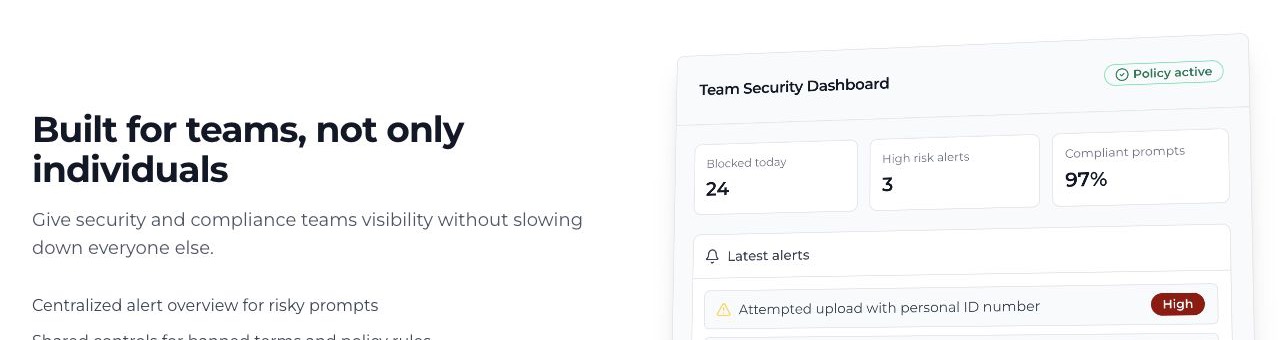
AIAmigo.io helps teams use tools such as ChatGPT, Claude, Gemini, and Copilot without accidentally sharing sensitive information. It combines a cross-browser extension that protects prompts and attachments with a SaaS platform for policies, teams, alerts, auditing, and subscriptions.
The problem
AI assistants are useful in everyday work, but copying internal information into a chat can expose personal, confidential, or business-sensitive data. Teams need protection at the moment a prompt is written or a file is attached, without sending that content to another remote analysis service.
The solution
I co-founded and developed a privacy-first platform built around two connected products:
- A WXT browser extension that detects, highlights, masks, and blocks sensitive data before it is sent.
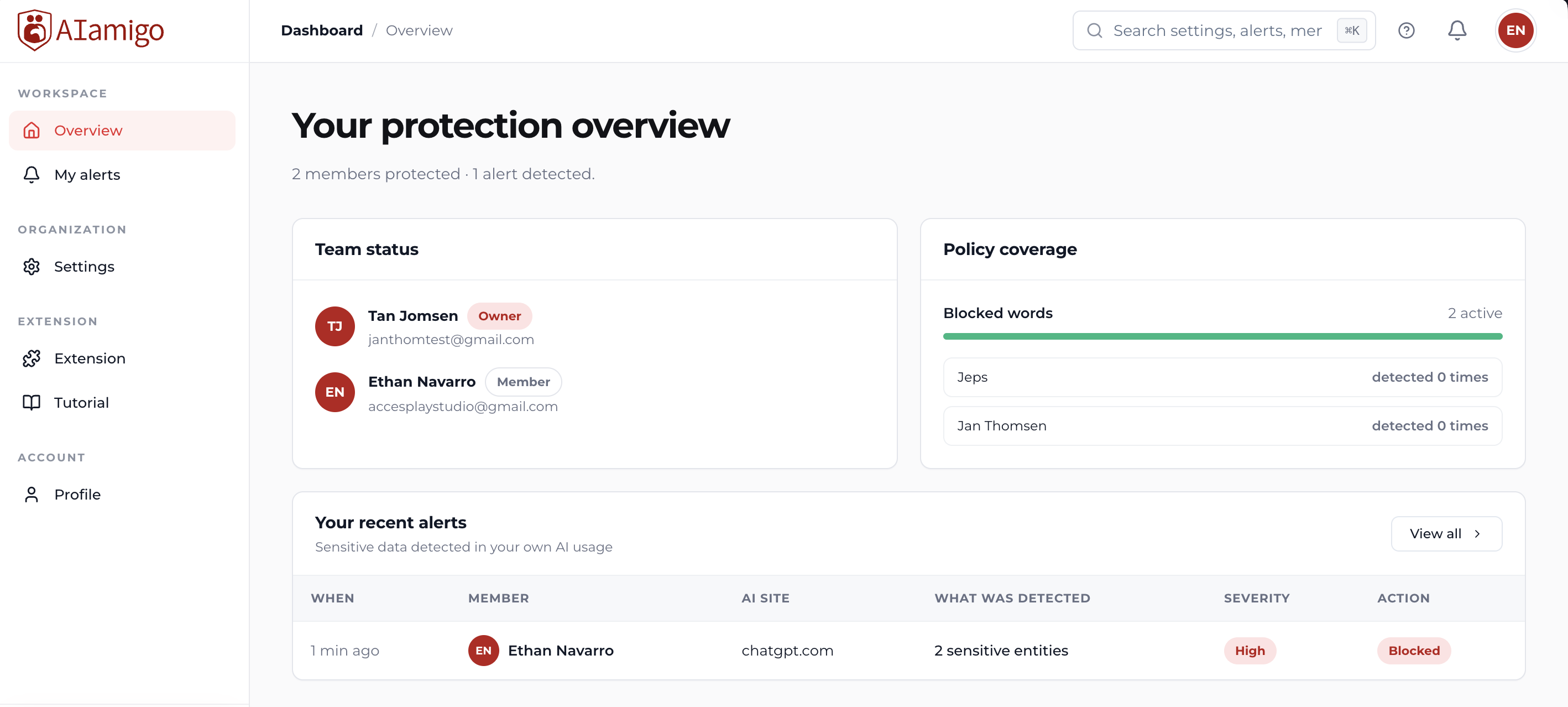
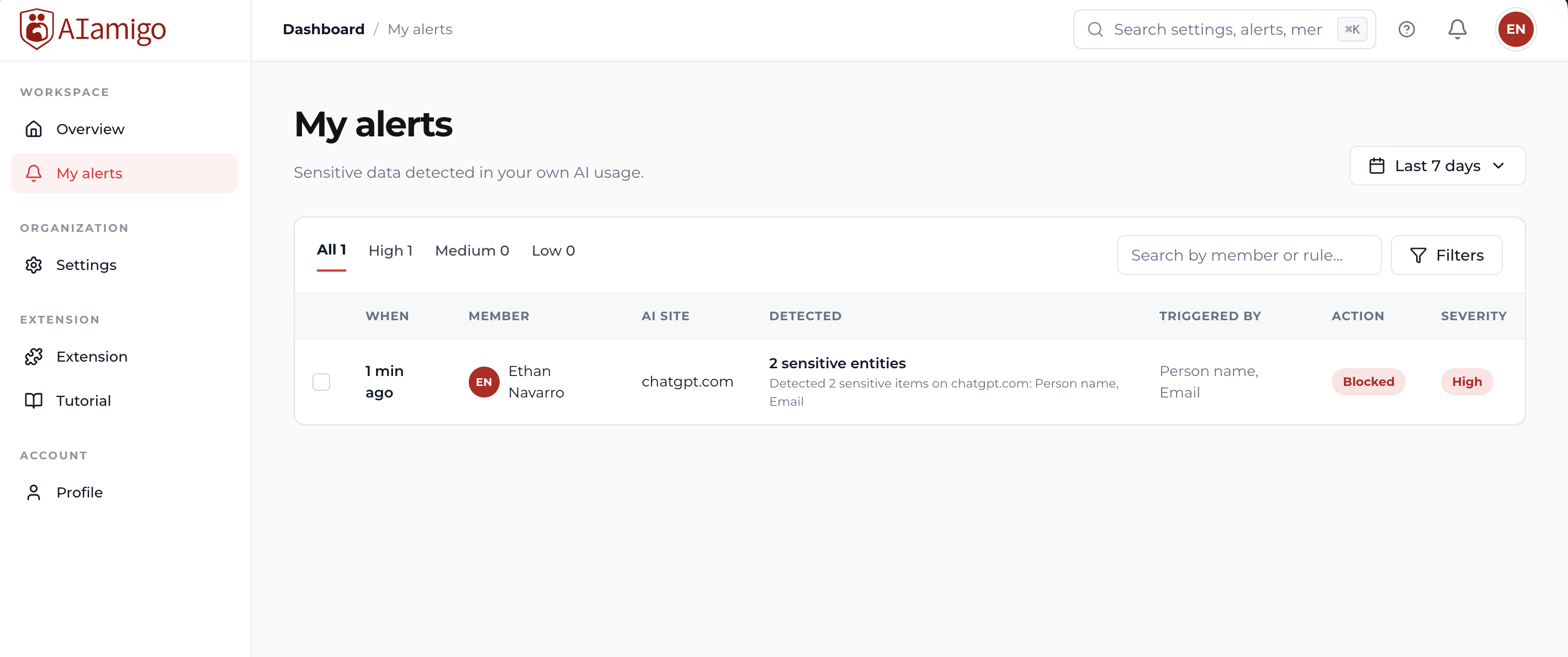
- A Next.js team platform for policies, custom banned terms, alerts, audit history, access control, and billing.
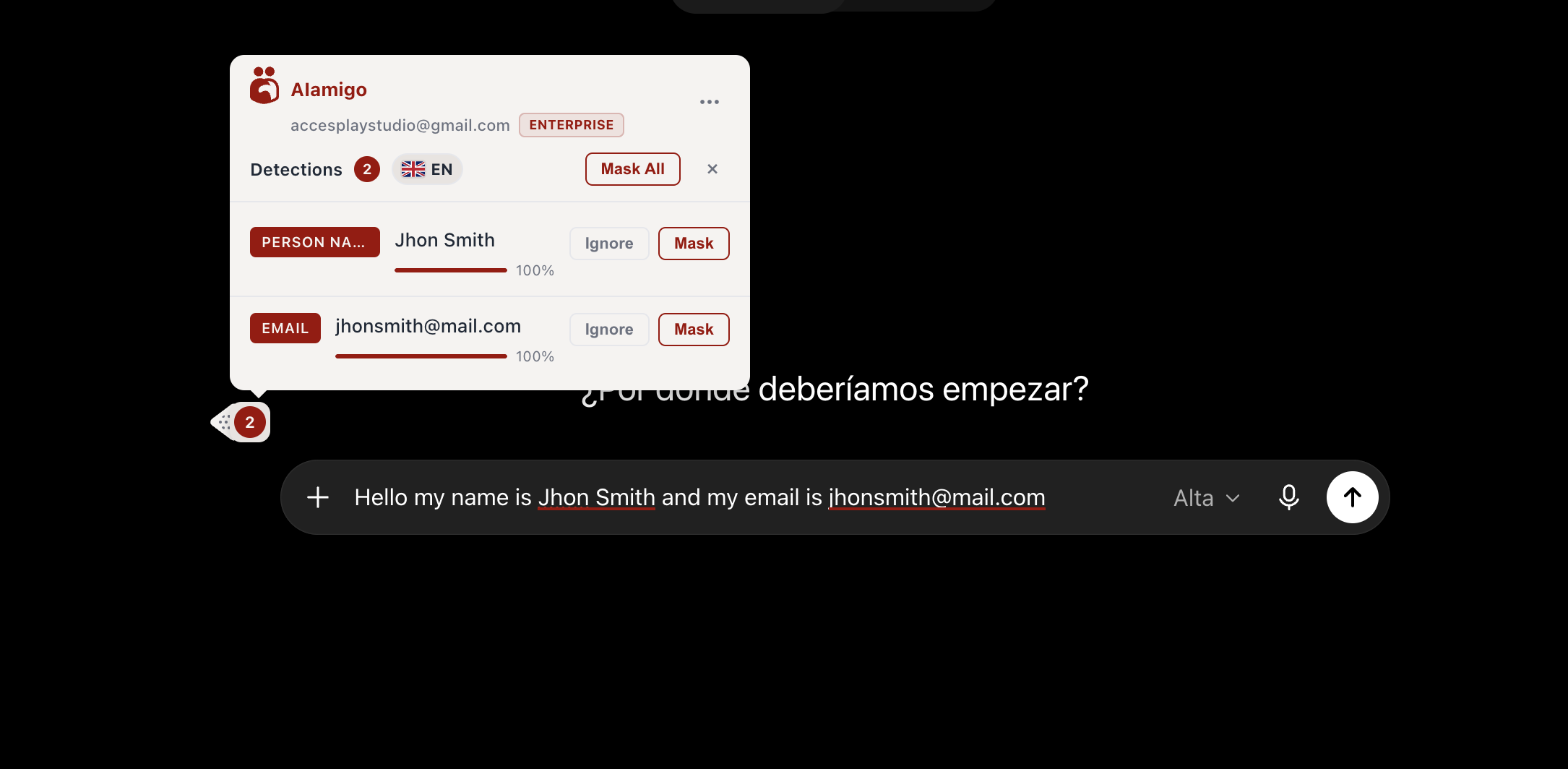
The detection pipeline combines the openai/privacy-filter model with fastText language detection, regional validators, GDPR Article 9 categories, and organization-specific blocked terms. Inference stays in the browser: it uses quantized WebGPU when available and an ONNX/WASM fallback on other devices.

My role
Co-Founder and Full-stack Developer
Responsibilities
- Designed and developed the SaaS platform with Next.js and React.
- Architected the WXT extension across content scripts, background services, offscreen inference, and isolated Shadow DOM interfaces.
- Built the hybrid detection and masking pipeline for personal identifiers, financial data, secrets, and GDPR special-category data.
- Added site-specific send protection for ChatGPT, Gemini, Claude, DeepSeek, Perplexity, Meta AI, and Microsoft Copilot.
- Implemented local scanning and anonymized export for PDF, DOCX, and plain-text attachments.
- Connected the extension to Supabase Auth and team APIs while keeping raw prompt content on the device.
- Built policy management, team alerts, role-based administration, audit logs, invitations, and seat-based Stripe billing.
- Shipped localized product experiences in English, Spanish, and Danish, with builds for Chrome, Edge, and Firefox.
Engineering highlights
- Local-first by design: prompts are analyzed and masked on-device; the SaaS receives policy data and redacted alert metadata rather than raw conversation text.
- Hybrid detection: model output is merged with country-specific identifiers, custom organization rules, and sensitive GDPR categories.
- Graceful hardware fallback: quantized WebGPU inference uses a q4 model, with a q8 WASM path when WebGPU is unavailable.
- Protected attachments: PDF, DOCX, and text files can be reviewed, anonymized, and exported before upload.
- Reliable team reporting: alerts use a persistent retry queue on the extension and idempotent ingestion on the server.
- Centralized governance: administrators can manage platforms, policies, blocked terms, team access, alert history, and audit events.
Stack
SaaS platform
- Next.js 16 + React 19 + TypeScript
- Supabase (Postgres, Auth, and SSR)
- Stripe subscriptions and enterprise seat billing
- Tailwind CSS + Radix UI / shadcn-style components
- next-intl for English, Spanish, and Danish
- React Email + Resend
Browser extension
- WXT + Manifest V3 for Chromium, React 19, TypeScript, and Tailwind CSS
- Transformers.js with
openai/privacy-filter - WebGPU and ONNX Runtime WASM
- fastText language detection and regional regex validators
- PDF.js, PDF-Lib, Mammoth, and docx for attachment processing
- Chrome, Edge, and Firefox build targets